
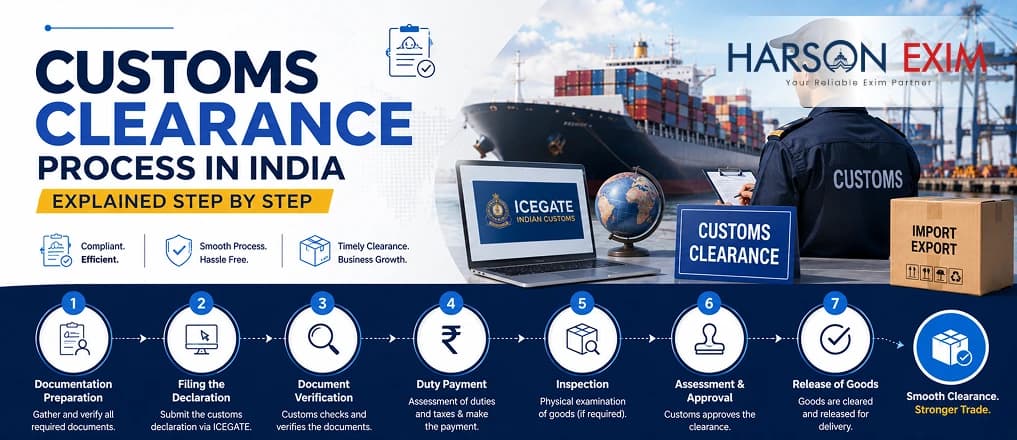
Customs Clearance Process in India Explained Step by Step
This guide explains the customs clearance process in India in simple language and covers what importers and exporters should know before shipping their goods.
What Is Customs Clearance?
Customs clearance is the process through which Indian Customs checks and authorizes imported or exported goods.During this process, Customs verifies information such as:
- Product description
- Quantity and value
- HS code
- Country of origin
- Applicable duties and taxes
- Required licenses or permits
- Supporting documents
Most customs documentation is handled electronically through ICEGATE, India's customs electronic portal. ICEGATE supports filing documents such as Bills of Entry and Shipping Bills and provides services for importers, exporters, and customs brokers.
Customs Clearance for Imports and Exports
- The process is slightly different depending on whether you are importing or exporting.
- For imports, the main customs declaration is the Bill of Entry.
- For exports, the main customs declaration is the Shipping Bill.
- ICEGATE's systems support electronic processing of both types of documents.
Step 1: Prepare Your Documents
Before the shipment reaches customs, prepare all required documents.Common documents include:
- Commercial invoice
- Packing list
- Bill of Lading or Airway Bill
- Import Export Code (IEC)
- Purchase order or contract, where applicable
- Certificate of Origin, where required
- Product-specific licenses or certificates
The exact documents depend on the product, shipment, and destination. Customs documentation may also include additional supporting documents required by participating government agencies.
Preparing documents correctly is important because incomplete or inconsistent information can result in queries and delays.
Step 2: Classify the Product Using the Correct HS Code
Every product involved in international trade needs an appropriate HS classification.The HS code helps determine:
- Applicable customs duties
- Import or export restrictions
- Required licenses
- Regulatory requirements
- Eligibility for certain benefits
Choosing the wrong HS code can result in incorrect duty calculation or compliance problems.
If you are unsure about classification, getting professional advice before shipping is better than trying to correct the problem after the goods arrive.
Step 3: File the Customs Declaration
- For imports, the importer or customs broker files the Bill of Entry.
- For exports, the exporter or customs broker files the Shipping Bill.
- These documents contain important details about the shipment, including the product description, quantity, value, classification, and other required information.
- ICEGATE provides electronic filing facilities for customs documents.
Step 4: Upload Supporting Documents
Supporting documents are submitted electronically through the customs system.Depending on the shipment, these can include:
- Commercial invoice
- Packing list
- Bill of Lading
- Airway Bill
- Licenses
- Certificates
- Product-specific approvals
The eSanchit system allows supporting documents to be uploaded and linked with the relevant Bill of Entry or Shipping Bill.
Step 5: Customs Assessment
After the declaration is submitted, Customs reviews the information.The assessment can involve checking:
- Product classification
- Declared value
- Applicable customs duty
- Exemptions or benefits claimed
- Import or export restrictions
The shipment may also be selected for further examination depending on applicable customs procedures and risk parameters.
Customs uses risk-based processing to determine whether additional documentary checks, inspection, testing, or referral to another government agency is required.
Step 6: Customs Examination, If Required
Not every shipment necessarily undergoes physical examination.If Customs selects a shipment for examination, the goods may be inspected to verify whether they match the information declared in the customs documents.
Customs may check:
- Product quantity
- Product description
- Packaging
- Marks and labels
- Declared classification
- Other regulatory requirements
If everything is found to be correct, the shipment can proceed to the next stage.
Step 7: Pay Applicable Customs Duties
For imports, applicable customs duties and taxes must generally be paid before the goods can be released.The amount depends on factors such as:
- Product classification
- Customs value
- Applicable duty rate
- Exemptions or concessions
- Other applicable taxes or charges
Export shipments generally follow a different duty and incentive structure, depending on the product and applicable policy.
Because duty calculations can vary significantly by product, exporters and importers should verify the applicable tariff before finalizing their transaction.
Step 8: Customs Clearance and Release
- Once the required documentation, assessment, examination, and payment requirements are completed, Customs allows the shipment to proceed.
- For imports, this means the goods can be released from customs control.
- For exports, the shipment can proceed toward loading and departure after the required customs formalities are completed.
- The exact release procedure can vary depending on the shipment type, port, customs system, and applicable regulations.
Step 9: Track the Shipment and Customs Status
- Importers and exporters should monitor their customs documentation and shipment status.
- ICEGATE provides online services for checking document and Bill of Entry status, among other customs-related services.
- Keeping track of the status helps businesses identify queries or pending actions early instead of discovering a problem after a shipment has already been delayed.
Common Reasons for Customs Clearance Delays
Customs delays can happen for several reasons.-
Incorrect Documentation
A mismatch between the invoice, packing list, Bill of Lading, and customs declaration can create problems. -
Wrong HS Code
Incorrect classification may result in reassessment, additional documentation, or other compliance issues. -
Incorrect Product Value
If the declared value does not satisfy applicable customs requirements, Customs may require additional verification. -
Missing Licenses or Certificates
Certain products require approvals from specific government agencies. -
Incomplete Supporting Documents
Missing documents can prevent Customs from completing the assessment or release process. -
Physical Examination
If the shipment is selected for examination, additional time may be required.
How a Customs Clearance Consultant Can Help
Importers and exporters often work with a customs broker or customs clearance professional to manage the process.A professional can help with:
- Customs documentation
- Bill of Entry filing
- Shipping Bill filing
- HS code guidance
- Supporting document submission
- Customs queries
- Duty-related documentation
- Coordination with Customs and logistics providers
This can be particularly useful for businesses handling international shipments for the first time.
However, hiring a consultant does not remove the importer's or exporter's responsibility to provide accurate information and comply with applicable laws.
Tips for Faster Customs Clearance
To reduce unnecessary delays:- Prepare documents before the shipment arrives.
- Verify the HS code carefully.
- Make sure invoice and packing-list information matches.
- Check whether your product needs special licenses or certificates.
- Declare the correct product value.
- Keep supporting documents ready.
- Monitor your customs status regularly.
- Use an experienced customs broker when necessary.
Good preparation is usually more effective than trying to fix documentation problems after the shipment reaches customs.
Customs Clearance for Businesses in Surat and Gujarat
Gujarat is one of India's important trade and manufacturing regions, with major activity in textiles, chemicals, pharmaceuticals, engineering products, diamonds, and other industries.Businesses involved in international trade may need regular support with customs documentation, shipping procedures, and logistics coordination.
For companies handling frequent shipments, having an experienced customs clearance partner can make the process more organized and reduce avoidable delays.