
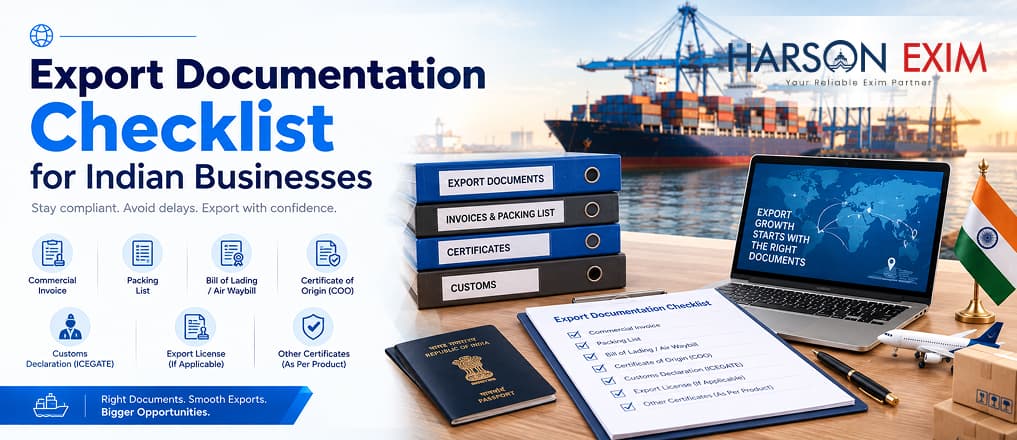
Export Documentation Checklist for Indian Businesses
Accurate documentation is a critical component of successful international trade for Indian exporters.
It ensures smooth customs clearance, reliable shipping, secure payments, and regulatory compliance. The specific documents required can vary significantly based on the product being exported, the destination country, and the nature of the transaction.
This comprehensive checklist explores the essential export documents required in India and provides guidance on preparing them correctly.
This comprehensive checklist explores the essential export documents required in India and provides guidance on preparing them correctly.
What Is Export Documentation?
Export documentation refers to the collection of documents required to facilitate an international trade transaction.These documents serve various roles:
- Commercial documents: Such as invoices and packing lists, detailing the transaction.
- Customs documents: Such as shipping bills, required for regulatory clearance.
- Transport documents: Such as Bills of Lading, serving as proof of carriage.
- Banking documents: Required for secure international payments.
- Regulatory documents: Such as licenses and certificates, ensuring compliance.
Maintaining consistent information across all these documents is vital to prevent customs delays and payment issues.
Essential Export Documents in India
Here are the foundational documents generally required for exporting from India:1. Importer Exporter Code (IEC)
The IEC is a mandatory business identification number issued by the DGFT.Purpose of IEC: It is required for all commercial international trade transactions.
Why it's needed: Exporters need it for customs clearance and international banking.
Key tip: Ensure your IEC details are always accurate and updated with the DGFT.
2. Commercial Invoice
The commercial invoice is the primary accounting document from the seller to the buyer. It should include:- Seller and buyer details
- Product description
- Quantity and price
- Currency
- Incoterms
- Payment terms
3. Packing List
A packing list provides detailed information about how the goods are packed for shipment. Key details include:- Package details (type and number)
- Gross and net weight
- Dimensions of packages
- Number of packages
- Product and shipment references
4. Shipping Bill
The Shipping Bill is the main customs document required for export clearance in India.Role: It serves as a formal declaration to customs about the goods being exported.
Filing: It requires detailed information for electronic filing via ICEGATE.
Relationship: It forms the basis for processing the export shipment and claiming export benefits.
5. Bill of Lading / Air Waybill
These are transport documents issued by the carrier.Bill of Lading (B/L): Used for ocean shipments. It acts as a receipt for goods, evidence of a contract of carriage, and a document of title.
Air Waybill (AWB): Used for air shipments. It serves as proof of carriage but is not a document of title.
6. Certificate of Origin
This document establishes the country where the goods were manufactured or produced.When it may be required: Often requested by the buyer, customs in the destination country, or for claiming preferential duty rates under trade agreements (Preferential vs non-preferential origin documentation).
Product-Specific Export Documents
Depending on the goods, additional specific documents may be required:- Product certifications
- Inspection certificates
- Health or phytosanitary certificates (where applicable)
- Fumigation certificates (where required)
- Test reports
- Export licenses or permissions for restricted products
Banking and Payment-Related Documents
Documents required to facilitate and secure international payments:- Purchase order
- Letter of credit (where applicable)
- Bank-related export documents
- Foreign exchange and payment records
It is critical that the invoice and shipment information precisely match the banking documents, especially when operating under a Letter of Credit.
Transport and Logistics Documents
Documents managed by freight forwarders and carriers:- Booking confirmation
- Bill of Lading
- Air Waybill
- Delivery instructions
- Insurance documents (where applicable)
Export Documentation Checklist Summary
| Document | Purpose | Usually Required? |
|---|---|---|
| IEC | Identifies the exporter for trade-related transactions | Generally |
| Commercial Invoice | Declares transaction and goods value | Generally |
| Packing List | Provides package and shipment details | Commonly |
| Shipping Bill | Export customs declaration | Generally |
| Bill of Lading / Air Waybill | Transport document | Depends on mode |
| Certificate of Origin | Confirms origin of goods | When required |
| Insurance Certificate | Evidence of cargo insurance | Where applicable |
| Product Certificates | Demonstrates regulatory compliance | Product-specific |
| Export License/Authorization | Permission for controlled goods | Where applicable |
How to Prepare Export Documents Correctly
Ensure accuracy by following these practices:- Use consistent product descriptions
- Verify quantity and weight
- Confirm HS classification
- Check buyer and consignee details
- Verify currency and value
- Confirm Incoterms
- Match information across invoice, packing list, and shipping documents
- Check destination-country requirements before dispatch
Common Export Documentation Mistakes
Avoid these frequent errors that can cause delays:- Incorrect HS code
- Mismatched invoice and packing-list information
- Incorrect consignee details
- Missing certificates
- Incorrect quantity or weight
- Incomplete product descriptions
- Using outdated regulatory requirements
- Submitting documents after shipment deadlines
Export Documents and Customs Clearance
Documents are central to customs processing:Role of the shipping bill: It dictates the customs assessment and examination process.
Importance of accurate declarations: Inaccurate documentation can lead to customs queries, physical examinations, and significant shipment delays.
Export Documentation for Different Products
Documentation requirements vary significantly by product category:- General manufactured goods
- Food and agricultural products
- Pharmaceuticals
- Chemicals
- Textiles and garments
- Machinery and industrial equipment
Each category can have additional requirements, such as health certificates for food or safety certifications for electronics.
Pre-Shipment Export Documentation Checklist
Before Shipment:- IEC verified
- Buyer details confirmed
- Purchase order reviewed
- HS code verified
- Commercial invoice prepared
- Packing list prepared
- Required product certificates obtained
- Export authorization checked
- Shipping booking confirmed
- Insurance arranged, if applicable
Before Customs Filing
Before Customs Filing:- Invoice and packing list match
- Quantity and weight verified
- Shipping bill information checked
- Product-specific permissions confirmed
- Destination-country requirements reviewed
After Shipment
After Shipment:- Transport document received
- Export records retained
- Payment documentation maintained
- Relevant customs and banking records filed
Conclusion
Accurate documentation is essential for smooth exports. The requirements depend on the product, destination, shipping method, and applicable regulations.Exporters should verify the latest requirements before every shipment.