
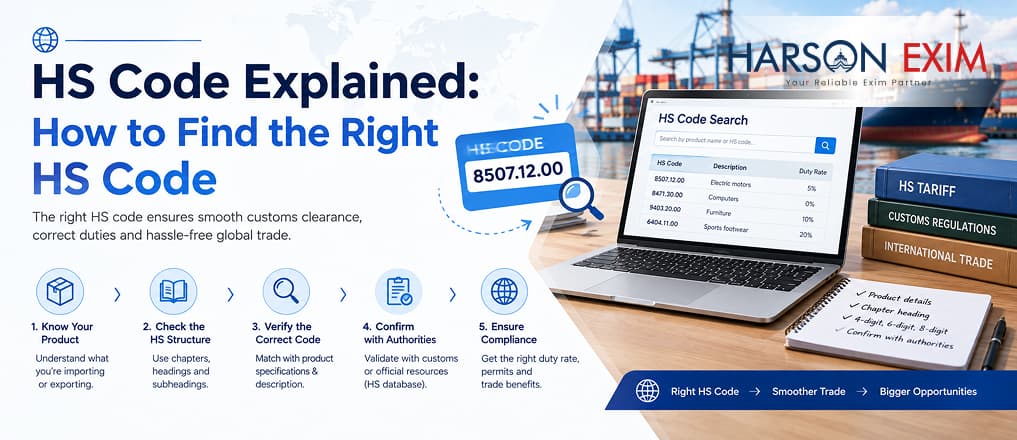
HS Code Explained: How to Find the Right HS Code
Correct product classification is a fundamental requirement in international trade. Whether you are importing goods into India or exporting products abroad, the customs authority needs to know exactly what the product is.
This classification is done using an HS code. Finding the correct HS code is essential because it determines the customs duties, trade policies, and documentation required for your shipment.
This guide explains what an HS code is, why it matters, and how to find the right classification for your product.
This guide explains what an HS code is, why it matters, and how to find the right classification for your product.
What Is an HS Code?
The Harmonized System (HS) code is an internationally standardized system of names and numbers to classify traded products.It was developed and is maintained by the World Customs Organization (WCO). Almost every country in the world uses the HS system as the basis for its customs tariffs and trade statistics.
While the first six digits of an HS code are identical worldwide, individual countries can add additional digits to further categorize products for their specific national tariffs and policies.
How HS Codes Work
The HS classification system is structured logically from broad categories to highly specific products:- Chapters (2 digits): Broad categories of goods (e.g., Chapter 61: Articles of apparel and clothing accessories, knitted or crocheted).
- Headings (4 digits): More specific groupings within the chapter.
- Subheadings (6 digits): The international standard level of classification.
- Additional digits (e.g., 8 digits in India): Used for country-specific taxation and trade policy rules.
HS Code vs HSN Code: What's the Difference?
| Term | Meaning & Common Use |
|---|---|
| HS Code | Harmonized System code - International classification of goods |
| HSN Code | Harmonized System of Nomenclature - Product classification primarily used for taxation and domestic trade in India |
| ITC(HS) Code | Indian Trade Classification based on HS - Import/export classification and India's trade policy |
Note: While the terms are often used interchangeably in India, ITC(HS) is the formal system used for import and export policy.
Why the Correct HS Code Is Important
Using the correct HS code is not just a formality; it directly impacts your business:- Customs duty calculation: The code determines the rate of duty you must pay.
- Import/export policy determination: It tells you whether a product is free, restricted, or prohibited to trade.
- Product-specific restrictions: Identifies if special permits or licenses are needed.
- Documentation: Ensures your commercial invoice and shipping documents are compliant.
- Statistical reporting: Helps governments track trade data.
- Regulatory compliance: Helps you avoid classification disputes, penalties, and shipment delays.
How to Find the Right HS Code
Follow these steps to determine the correct HS code for your product:- Identify the product precisely: Know exactly what it is.
- Understand its material and composition: What is it made of?
- Determine its function and intended use: What does it do?
- Check the relevant HS chapter: Start with the broad category.
- Review headings and subheadings: Narrow down the classification.
- Compare product descriptions carefully: Read the section and chapter notes.
- Verify the applicable Indian classification: Use the ITC(HS) schedule.
- Check current customs requirements: Confirm the policy before shipment.
Information You Need Before Searching for an HS Code
To accurately classify a product, gather the following details:- Product name
- Material/composition
- Function
- Manufacturing process
- Technical specifications
- Product form or condition
- Intended use
- Packaging, where relevant
Example of HS Code Classification
Consider classifying a wooden chair.First, you must ask: What is it made of? (Wood). What does it do? (It's a seat/furniture).
You wouldn't look in Chapter 44 (Wood and articles of wood) because there is a more specific chapter for furniture.
You would look in Chapter 94 (Furniture).
Heading 9401 covers "Seats (other than those of heading 94.02), whether or not convertible into beds, and parts thereof."
Subheading 9401.61 covers "Other seats, with wooden frames: Upholstered."
Important: The exact HS/ITC(HS) classification should be verified against the current official tariff and product-specific rules rather than relying only on a generic online search.
Common HS Code Classification Mistakes
Avoid these frequent errors when classifying your goods:- Choosing a code based only on the product's common name.
- Using an outdated HS code.
- Confusing similar products.
- Ignoring product composition.
- Selecting a code based only on the supplier's invoice without verification.
- Using an international six-digit code when India's additional eight-digit ITC(HS) digits are required.
- Failing to check import/export policy conditions.
HS Code and Customs Duty
Your product's classification directly affects the applicable customs duty rate. Incorrect classification can result in paying too much duty or, worse, paying too little and facing penalties later.The HS code should be confirmed before calculating landed cost. Also, remember that other factors, such as the country of origin and applicable trade agreements, can affect customs duty besides the basic classification.
HS Code and Import/Export Documentation
The correct HS code must appear consistently across all your trade documents, including:- Commercial invoice
- Packing list
- Shipping bill
- Bill of Entry
- Certificates and licenses where applicable
Inconsistencies in product descriptions and HS codes across documents are a common cause of customs delays.
How to Verify an HS Code
If you are unsure about your product's classification:- Check the current Indian tariff/classification sources (like the ICEGATE portal).
- Review the applicable ITC(HS) entry in the DGFT schedule.
- Check customs requirements.
- Seek professional classification advice for complex products from a customs broker or consultant.
- Keep evidence supporting your classification decision in case of customs queries.