
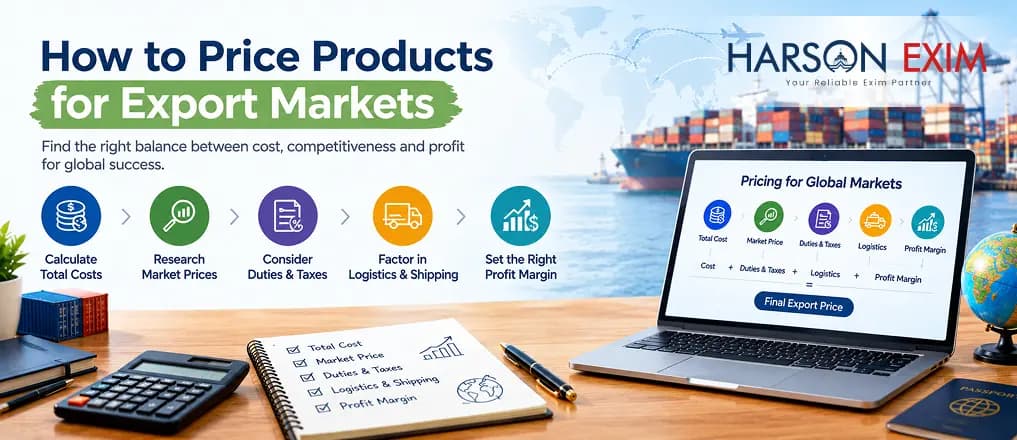
How to Price Products for Export Markets: A Guide
Pricing products for export markets requires striking a precise balance between maintaining global competitiveness and securing sustainable, healthy profit margins.
Export pricing differs fundamentally from domestic pricing. When selling overseas, Indian manufacturers and exporters must account for international logistics, marine insurance, customs tariffs, currency volatility, distributor margins, and diverse buyer requirements.
Underpricing risks eroding profitability and straining cash flow, while overpricing can immediately alienate foreign buyers in competitive tenders. This step-by-step guide walks you through calculating total export costs, researching international market prices, selecting pricing methods, navigating Incoterms, managing currency fluctuations, and formulating winning export price quotations.
Underpricing risks eroding profitability and straining cash flow, while overpricing can immediately alienate foreign buyers in competitive tenders. This step-by-step guide walks you through calculating total export costs, researching international market prices, selecting pricing methods, navigating Incoterms, managing currency fluctuations, and formulating winning export price quotations.
1. Why Export Pricing Matters for International Business
Export pricing is the foundation of sustainable international trade expansion. It directly influences your market penetration, buyer trust, and commercial viability:Key strategic considerations include:
- Balancing competitiveness and profitability: Your price must be attractive enough to entice overseas buyers away from local or global competitors while generating sufficient margins to sustain business growth.
- Understanding international cost structures: Exporting incurs numerous overheads that domestic sales never encounter, including international freight, terminal handling, export packaging, marine insurance, and bank documentation fees.
- Mitigating commercial risks: A single miscalculated container shipment with unexpected demurrage, detention, or tariff classification charges can eliminate your entire operating profit if not accounted for upfront.
2. What Is Export Pricing?
Export pricing is the systematic methodology of determining selling prices for goods delivered to buyers in overseas destinations. It is significantly more intricate than domestic pricing due to multiple cross-border variables:- Definition of export pricing: The strategic process of fixing product prices that cover production, international logistics, customs compliance, and financial risk allowances while meeting target market expectations.
- Domestic vs. international pricing differences: Domestic pricing primarily covers domestic manufacturing, local transport, and standard tax compliance (such as GST). Export pricing excludes domestic taxes (eligible for GST refunds or Letter of Undertaking - LUT) but incorporates overseas freight, port charges, export packaging, international compliance, and foreign exchange risks.
- Key factors influencing export prices: Destination country demand, local purchasing power, competitor benchmark prices, regulatory compliance standards, and transportation distance.
- Variations by destination country and buyer requirements: Pricing structures must adapt to destination import tariffs, specific shipping lanes, distributor margins, order volume commitments, and customized packaging requirements.
3. Calculate Your Total Product Cost
The foundation of any profitable export transaction is an exhaustive calculation of your total cost of production and export readiness. Avoid approximations—calculate every component down to the unit level:- Raw materials and manufacturing expenses: Direct cost of raw materials, consumable supplies, and factory overheads incurred in fabricating the finished product.
- Labor and production overheads: Direct production labor, machine run-time costs, factory power consumption, equipment depreciation, and supervisory expenses.
- Export packaging and labeling: Specialized international seaworthy packaging (fumigated wooden pallets, desiccants, heavy-duty corrugated cartons, shrink wrap) and destination-compliant labeling (barcodes, multilingual instructions, hazardous symbols).
- Quality testing and inspection: Pre-shipment inspection fees (e.g., SGS, Bureau Veritas), laboratory testing, Certificate of Analysis (COA), and batch quality certifications.
- Warehousing and handling: Factory storage, inland warehouse staging, and palletization prior to container stuffing.
- Export documentation and compliance expenses: Legalization costs, Certificate of Origin issuance, DGFT filing fees, and specialized product compliance documentation.
4. Research International Market Prices
Before finalizing your export quotation, benchmark your prices against what buyers are actively paying in your target destination:- Study competitors in the target country: Identify both local domestic producers and third-country international exporters serving the same market segment.
- Compare similar products and quality standards: Evaluate how your product's specifications, durability, and packaging compare against existing marketplace standards.
- Research local demand and purchasing power: Assess consumer affordability and willingness to pay, considering local inflation, disposable income, and economic conditions.
- Analyze wholesale prices and distributor margins: Overseas distributors, wholesalers, and retail chains typically expect gross margins of 20% to 50% depending on the industry and distribution tier.
- Position your product strategically: Decide whether your export brand enters as a budget-friendly value offering, a competitive mid-range alternative, or a premium high-specification product.
5. Include Shipping and Logistics Costs
Logistics represent one of the largest cost components in international trade. Depending on the agreed Incoterm, accurately calculate all transport and handling charges:- Inland transportation to the port: Factory-to-port road or rail freight (e.g., transport from an inland container depot or industrial cluster to Nhava Sheva, Mundra, or Chennai port).
- Freight charges for sea, air, or road: Ocean freight rates for FCL (Full Container Load) or LCL (Less than Container Load), air freight charges based on chargeable volumetric weight, or cross-border trucking.
- Port handling and terminal charges (THC): Container yard handling, wharfage, crane lifts, gate charges, and container stuffing/destuffing expenses.
- Customs clearance and documentation fees: Custom House Agent (CHA) professional charges, EDI shipping bill generation, and documentation filing.
- Cargo insurance: Comprehensive Marine Cargo Insurance (Institute Cargo Clauses A, B, or C) covering transit perils, theft, damage, and general average.
- Destination delivery costs: If quoting under DPU or DDP terms, calculate destination terminal handling, import customs clearance, and inland trucking to the buyer's warehouse.
6. Understand Customs Duties and Taxes
Tariffs, trade agreements, and border taxes directly impact landed costs and the importer's final purchase decision:- Export duties in India: While most manufactured goods in India are free of export duty or enjoy export incentives (like RoDTEP and Duty Drawback), verify if your specific HS code attracts an export cess or duty.
- Import duties in the destination country: The importing country's customs authority levies tariffs based on the product's 6 to 8-digit Harmonized System (HS) code.
- Applicable taxes and product-specific charges: Value-added tax (VAT), Goods and Services Tax (GST), anti-dumping duties, or environmental levies imposed at destination ports.
- Impact of Free Trade Agreements (FTAs): Preferential trade agreements (such as India-UAE CEPA, India-Australia ECTA, or ASEAN agreements) can reduce or eliminate import tariffs if a valid Certificate of Origin is provided.
- Role of Incoterms in tax obligations: Under DDP terms, the exporter must pay destination import duties and taxes; under CIF/FOB/EXW terms, the foreign buyer is responsible for import tariffs.
- Verify rates before quoting: Customs tariffs, retaliatory duties, and trade remedy measures change frequently; always verify current tariff schedules via the Indian Trade Portal or destination customs portals.
7. Choose the Right Export Pricing Method
Selecting the optimal pricing methodology depends on your production cost flexibility, market entry objectives, and competitive advantages:- Cost-Plus Pricing: Calculate your total landed export cost and add a predetermined profit percentage (markup). This ensures all operational costs are covered and is standard for contract manufacturing.
- Competition-Based Pricing: Set export prices directly in relation to prevailing quotes offered by key domestic and international competitors in the destination market.
- Value-Based Pricing: Price your product based on the perceived value, unique patented technology, high durability, or specialized certifications that benefit the buyer.
- Penetration Pricing: Set lower, highly competitive prices initially to enter a new foreign market, win tender contracts, and build customer loyalty before normalizing rates.
- Premium Pricing: Charge a premium price supported by superior quality, luxury branding, rare craftsmanship, or proprietary certifications.
8. Understand FOB, CIF, and Other Incoterms
Incoterms (International Commercial Terms) established by the International Chamber of Commerce (ICC) define the precise division of costs, risks, and transport responsibilities between the exporter (seller) and importer (buyer). Selecting the correct Incoterm is critical for accurate export price quoting:| Incoterm | Pricing Consideration |
|---|---|
| EXW (Ex Works) | Generally covers goods made available at the seller's premises. The buyer bears all freight, transport, customs clearance, and risk from the seller's factory onwards. |
| FCA (Free Carrier) | Includes delivery and export clearance to the agreed carrier or named location under the applicable ICC rule. Suitable for all transport modes. |
| FOB (Free on Board) | Seller handles delivery, export clearance, and loading on board the vessel at the named port of shipment. Specifically intended for sea or inland waterway transport. |
| CFR (Cost and Freight) | Seller pays ocean freight to bring goods to the named destination port. Marine cargo insurance is not included as a seller obligation. |
| CIF (Cost, Insurance & Freight) | Seller covers cost, marine cargo insurance, and freight to the named destination port. Specifically for sea or inland waterway transport. |
Important Rule for Exporters: Every Incoterm in your price quotation must specify the exact named place or port (e.g., 'FOB Nhava Sheva, Incoterms® 2020') and reference the applicable ICC rule version. Note that traditional maritime rules like FOB and CIF are not intended for multimodal container transport or air freight, where FCA, CPT, and CIP should be quoted instead.
9. Account for Currency Exchange Rates
Foreign currency volatility can erode profit margins if exchange rate risks are not proactively managed during price quotation:- Choose the quotation currency: Quote in globally recognized currencies such as USD, EUR, GBP, or AED, or explore INR-based trade settlements where bilateral mechanisms exist.
- Monitor exchange-rate fluctuations: Track currency trends and avoid basing multi-month contracts on a single day's spot rate.
- Include a reasonable currency-risk allowance: Add a 2% to 5% buffer in long-term quotations to cushion against unexpected currency devaluations.
- Factor in bank conversion and transaction charges: Account for inward remittance fees, NOSTRO/VOSTRO charges, and foreign exchange conversion spreads charged by authorized dealer banks.
- Set strict quotation validity periods: State explicitly on your proforma invoice that quotes are valid for a fixed period (e.g., 15 or 30 days) to prevent honoring old rates after sharp currency or freight shifts.
- Review payment terms and foreign-exchange exposure: For large contracts, utilize forward exchange contracts with your bank and secure export transactions through Irrevocable Letters of Credit (LC) or ECGC credit insurance.
10. Calculate Your Export Price and Profit Margin
Setting the right export price requires a disciplined mathematical formula to ensure that every expense is recovered while yielding healthy profit margins.Basic Export Pricing Formula:
Export Selling Price = Total Export Cost + Desired ProfitTarget Profit Margin Formula:
When targeting a specific profit margin (the percentage of the final selling price that represents profit), use the following formula:
Selling Price = Total Cost / (1 - Target Margin)Practical Calculation Example:
Suppose the total cost of a shipment from India (including manufacturing, export packaging, inland transport, port handling, and customs clearance) is ₹1,00,000, and your business aims for a 20% target profit margin (0.20):
Selling Price = ₹1,00,000 / (1 - 0.20) = ₹1,00,000 / 0.80 = ₹1,25,000The resulting profit is ₹25,000, which represents exactly 20% of the ₹1,25,000 selling price before any unallocated overheads.
Markup vs. Profit Margin Warning: Confusing markup with profit margin is one of the most common pitfalls for new exporters. A 20% markup on ₹1,00,000 cost yields a selling price of ₹1,20,000 (earning ₹20,000 profit, which is only a 16.67% profit margin). Always use the target margin formula to avoid underpricing your export consignments.
11. Prepare a Professional Export Price Quotation
A comprehensive, unambiguous export quotation (Proforma Invoice) prevents disputes and accelerates buyer confirmation:- Product specifications and quantity: Clear technical description, HS code, grade, dimensions, and minimum order quantity (MOQ).
- Unit price and total order value: Stated clearly in the agreed quotation currency.
- Currency: Explicitly mention currency denomination (e.g., USD $, EUR €, INR ₹).
- Applicable Incoterm and named place: E.g., 'FOB Port of Nhava Sheva, India (Incoterms® 2020)'.
- Packaging and delivery lead time: Describe seaworthy packaging, pallet dimensions, total net/gross weight, and production lead time.
- Payment terms: E.g., '30% advance via T/T, 70% against Bill of Lading copy' or '100% Irrevocable LC at sight'.
- Quotation validity period: E.g., 'Valid for 21 days from date of issue'.
- Freight, insurance, and surcharge disclosures: Clarify whether freight rates are fixed or subject to ocean bunker adjustment factors (BAF).
- Certifications and compliance conditions: List included quality certificates (ISO, CE, phytosanitary, or fumigation certificates).
12. Common Export Pricing Mistakes to Avoid
Exporters frequently compromise profitability due to avoidable pricing oversights:- Ignoring hidden costs: Overlooking terminal handling fees, palletization expenses, phytosanitary inspection charges, or courier fees for document dispatch.
- Confusing markup with profit margin: Applying a 20% markup when your business plan requires a 20% margin, resulting in lower realized income.
- Underestimating freight and packaging expenses: Using outdated shipping quotes or standard domestic cartons that fail during ocean transit.
- Using outdated exchange rates: Calculating quotes with favorable historical exchange rates rather than current interbank rates.
- Misunderstanding Incoterms: Agreeing to terms like CIF or DDP without understanding who bears destination demurrage, inspection, or customs risks.
- Quoting without researching the target market: Proposing prices that are 30% higher than prevailing market rates or too cheap to be considered credible.
- Forgetting bank charges and payment risks: Ignoring the 1% to 3% bank fees charged on international LCs and foreign wire transfers.
- Offering prices without a validity period: Being legally bound to quote prices months later after ocean freight or raw material prices have doubled.
13. Conclusion
Effective export pricing is an ongoing strategic discipline rather than a one-time calculation. Success in international trade depends on balancing price competitiveness with sustainable profitability.By rigorously calculating total product costs, benchmarking target destination markets, choosing suitable Incoterms, budgeting for logistics and currency volatility, and issuing transparent price quotations, Indian exporters can win lucrative global contracts while protecting their bottom line.
As ocean freight rates, international regulations, and market conditions fluctuate, regularly reassess your export pricing frameworks to maintain agility and long-term global competitiveness.